During the 18th and 19th centuries, Malmesbury was one of England’s most notorious ‘rotten boroughs’. The term came into use in the mid18th century to describe those parliamentary constituencies whose electorates had shrunk to a handful of voters, while they continued to send Members to the House of Commons. Wiltshire had several such boroughs, including Wootton Bassett, Cricklade, Great Bedwyn and Westbury. Most notable was Old Sarum, which mostly had no residents, but continued to send two MPs to Westminster.
Malmesbury first sent burgesses to Parliament in 1275. Thereafter the town was empowered to send two representatives to Parliament at each election. By the time of the 1801 census the population of Malmesbury stood at more than 1500. However, voting was limited to the Alderman and 12 capital burgesses of the Old Corporation. This group exercised control over local affairs and the election of MPs. Because of this limited franchise, the town’s political system was prey to electoral manipulation, where a small powerful group bartered parliamentary seats for personal wealth, leaving most local citizens entirely disenfranchised. Wealthy political patrons were quick to see the potential for systematic transactional bribery.
In the mid to late 18th century, control of the borough was fiercely contested by wealthy aristocratic families and local power brokers. Perhaps the most notable was Edmund Wilkins, a local apothecary and the steward of the corporation between 1775 and 1804, who established a formidable political monopoly. Wilkins paid an annual retainer to each of ten of the capital burgesses of £30 (equivalent to thousands of pounds today). With their votes secured, Wilkins could sell the seat to the highest bidder. To guarantee their absolute loyalty and prevent dissent, Wilkins held a legal bond from each burgess, worth a staggering £500, a sum that would completely ruin them if they ever voted against his wishes.
This practice was widespread and captured in this cartoon from the British Museum
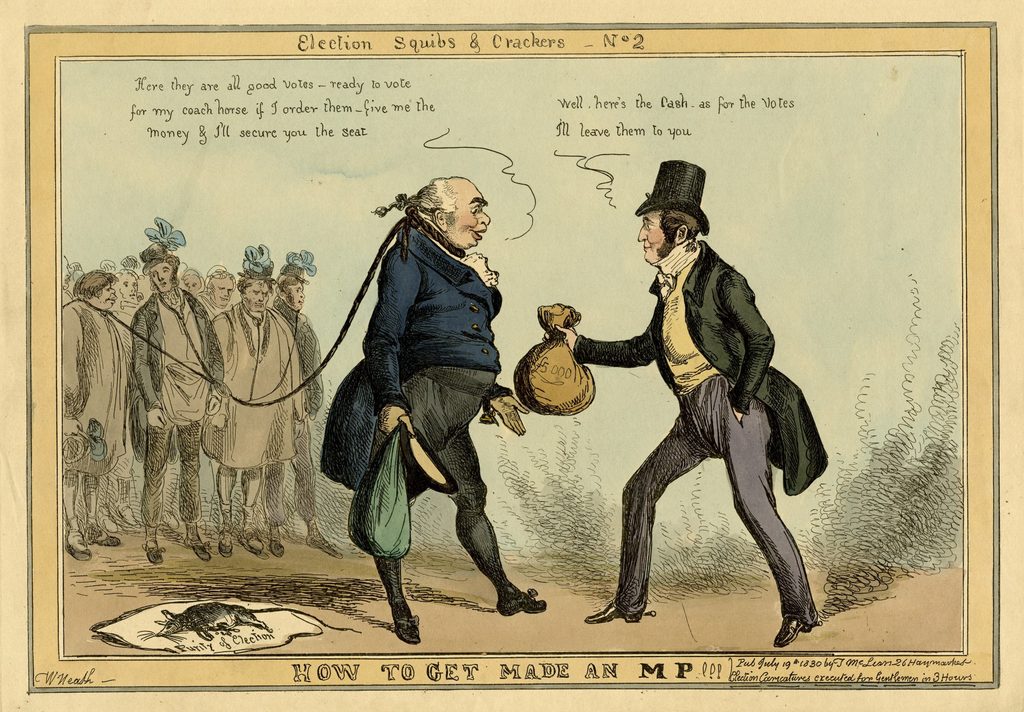
By the turn of the 19th century, the bribery ritual became legendary. Before an election, the 13 voters were invited to a lavish feast. For dessert, a plate was brought out containing a single cheesecake. Underneath the pastry, the burgesses would find cash—frequently £30 to £50—which exceeded what an average local labourer could earn in an entire year.
Wilkins was succeeded as the local political fixer by Joseph Pitt, a self-made man, who would sell parliamentary seats to wealthy outsiders for thousands of pounds.
Sir Charles Forbes, MP for Malmesbury, between 1818 and 1832, was rumoured to have spent 12,000 guineas for his parliamentary seats for himself and his son. This sum would be in excess of £1.5 million today.
The depth of this corruption was exposed during parliamentary inquiries, which noted that “Even in the county of Wiltshire where there are so many sinks of impurity and corruption, the Borough of Malmesbury stands pre-eminent”.
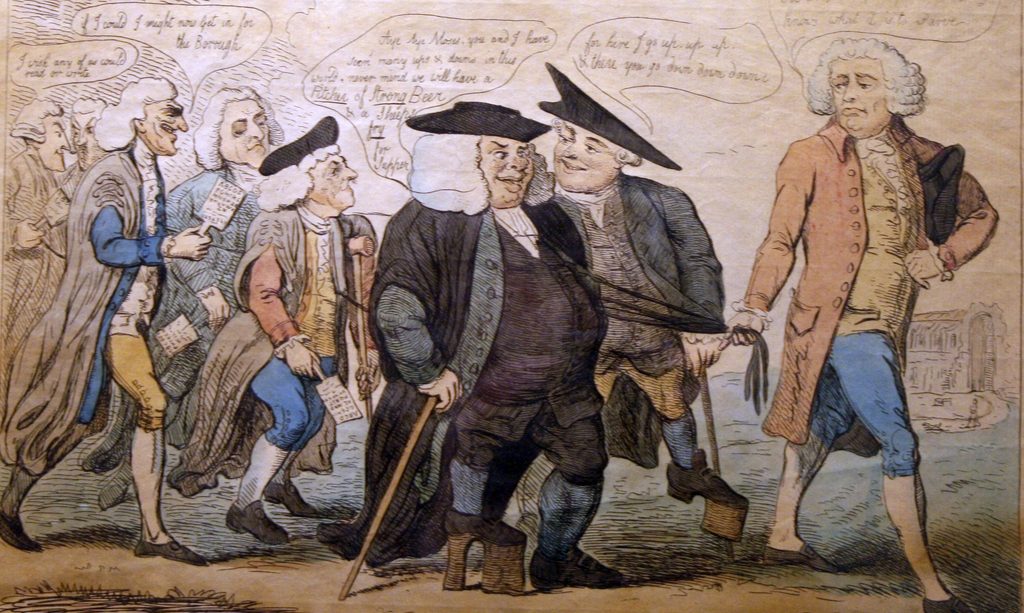
The Museum has in its collection this political cartoon, ‘The Antiquities of Malmsbury’ which captures the situation described.
This lucrative system faced its first major blow with the Reform Act 1832. The act sought to dismantle the rotten borough system by disenfranchising depopulated towns and expanding the electorate. Because of its small size and deep-seated corruption, Malmesbury was stripped of one of its two parliamentary seats, and its boundaries were extended to include neighbouring parishes to increase the voter base. The electorate for Malmesbury expanded to 291 voters.
Despite these changes, the Old Corporation continued to exercise local political control until the passing of the Municipal Corporations Act of 1882, which led to creation of an elected borough council in 1886. The Old Corporation lost its powers over local affairs and became the Warden and Freemen of Malmesbury. The Warden and Freemen continued to support the community with grants and donations for apprentices, education, local groups, schools and for Commoners experiencing hardship, as they do today.
Malmesbury’s independent national political identity was finally lost with the Redistribution of Seats Act 1885. This legislation abolished the constituency entirely and the historic borough became part of the wider North-Western (or Chippenham) Division of Wiltshire.
In 1983 Malmesbury was moved into the newly created North Wiltshire constituency and in 2024 moved once more, into the South Cotswolds constituency.